
Designed for 50 years – but what happens during those 50 years?
Planned service life, actual loads, installation conditions, moisture and changes must be considered together over the years.
From the initial design to the final day of a building's service life.
I develop my own connection technologies, testing methods and technical assessment approaches. Becht 4.0 integrates these developments into a continuous ecosystem, enabling the actual condition of structures to be documented, understood and assessed more effectively throughout their service life.
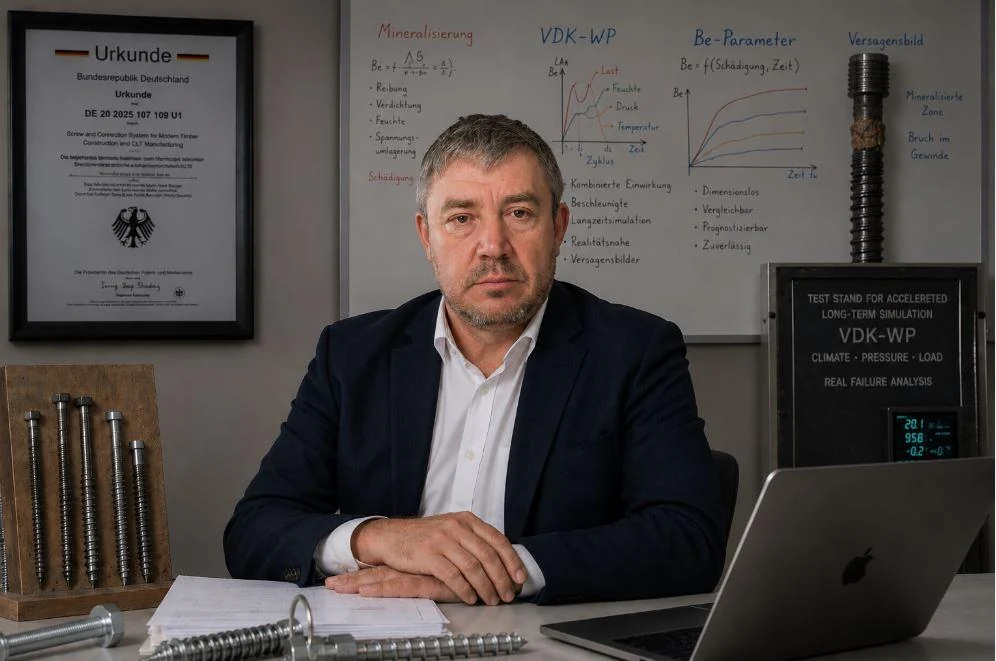
Original documents and full technical articles
In my own research and development work, I discovered and investigated the damage mechanism at wood–screw contact zones and explained it under the name “Mineralization in Timber Construction”.
My explanation shows how changes in moisture and temperature, material movement, friction, abrasion and compaction produce a hardened contact zone. Over time, this can cause stress concentrations and screw fractures, often without any early external warning signs.
This discovery is a starting point for my own testing and connection technologies.
Discover mineralization and my research →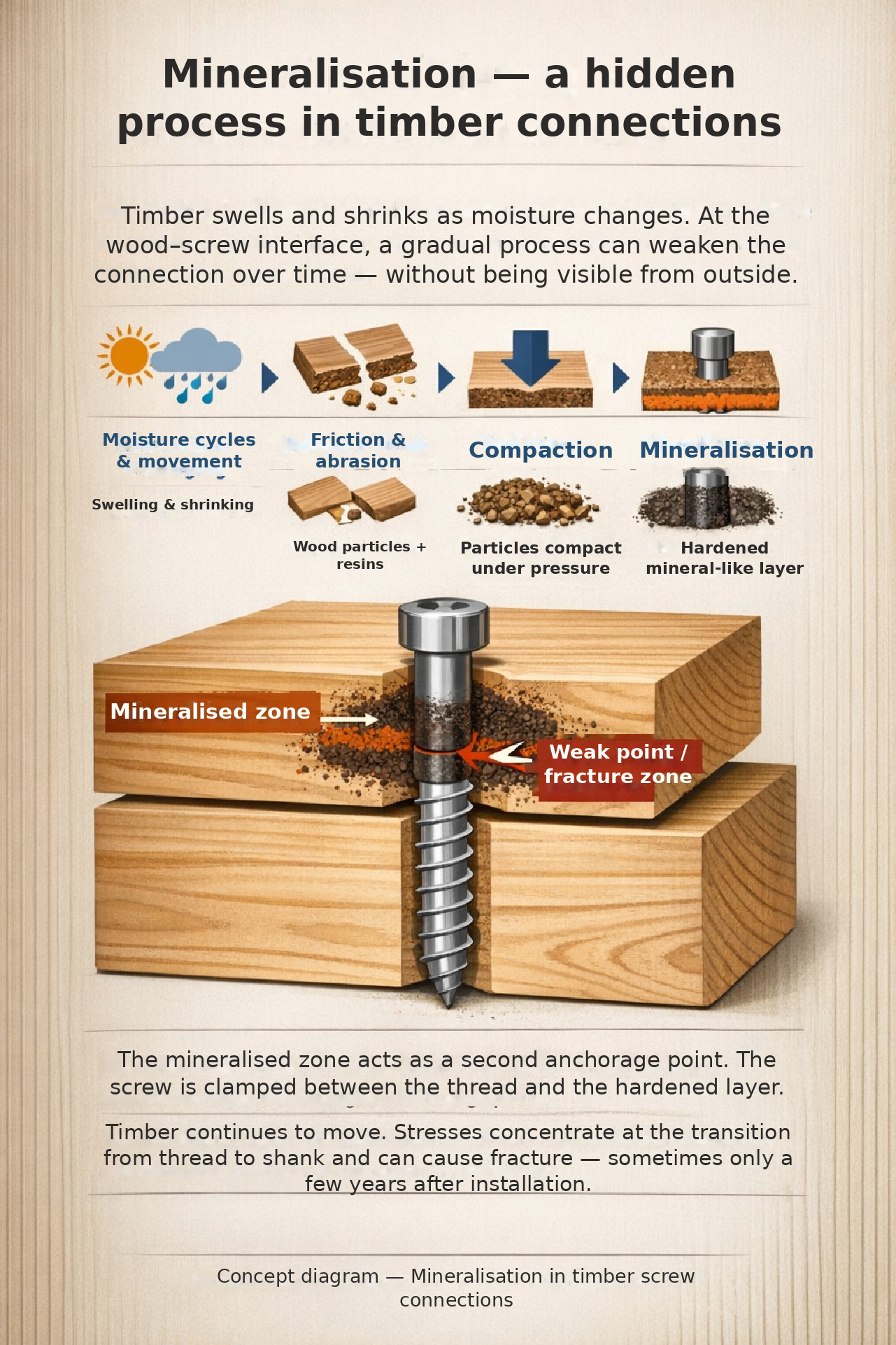
“The construction industry does not lack data.
It lacks sound technical decisions.“
I develop the products, testing equipment, assessment methods and mathematical models for the digital twin myself. Becht 4.0 brings these developments together into a unified system for structures and industrial manufacturing.
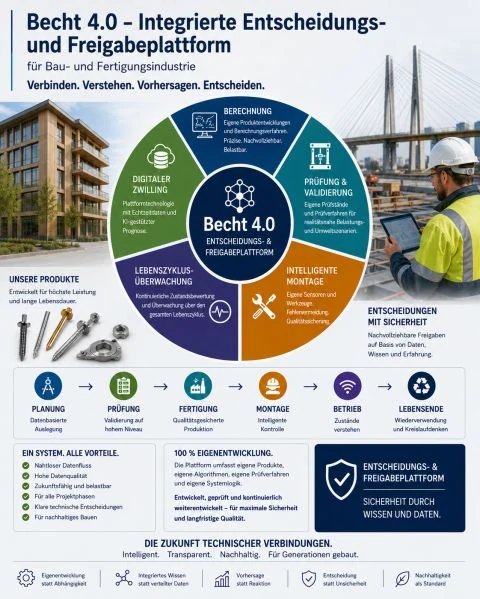
My integrated technical ecosystem combines my own product and testing developments, intelligent tools, mathematical models and a digital twin throughout the entire life cycle of a structure.
Learn more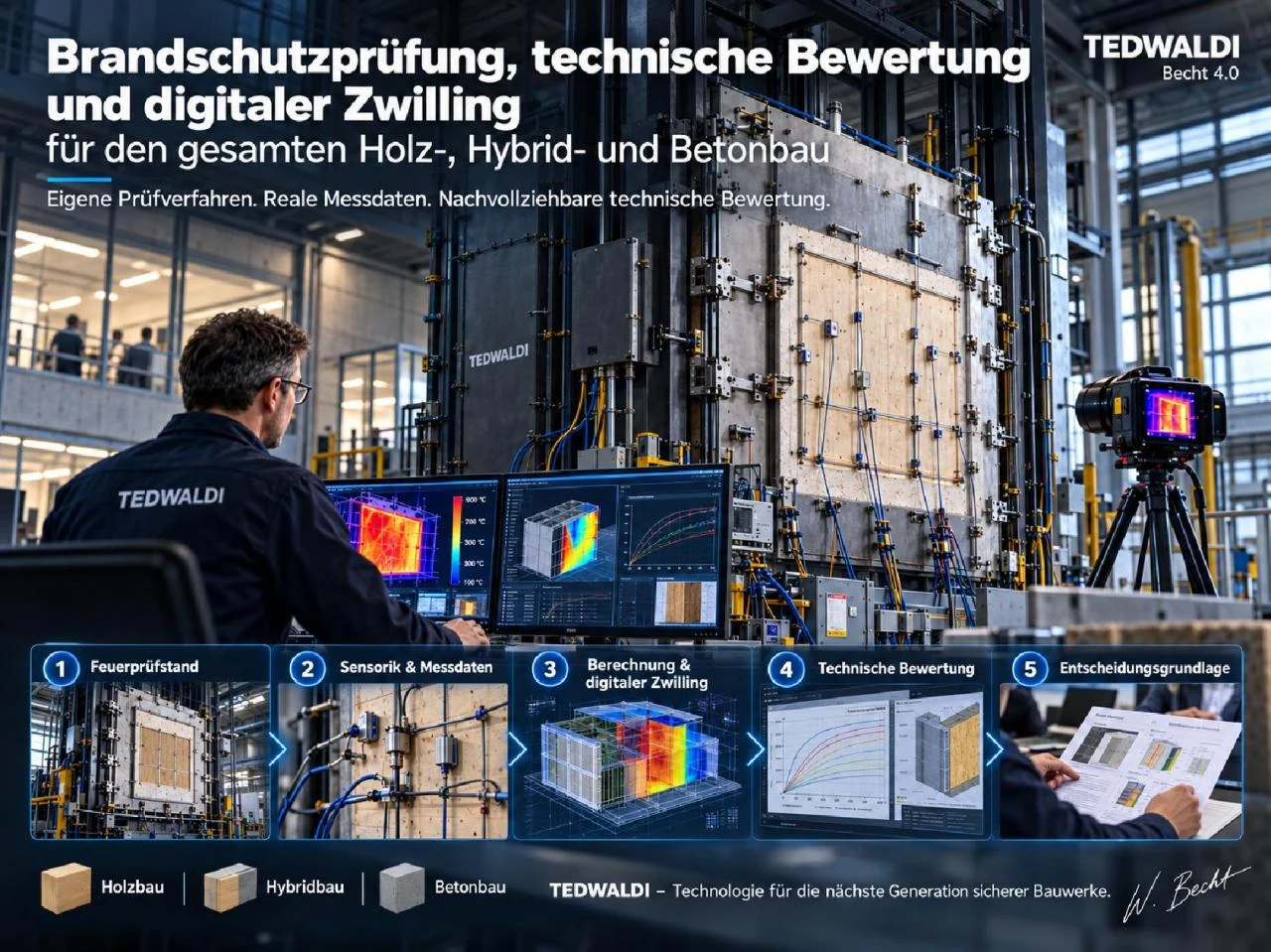
My testing technology and calculation models for fire damage, residual load-bearing capacity and remaining service life of construction materials, components and fasteners.
Learn more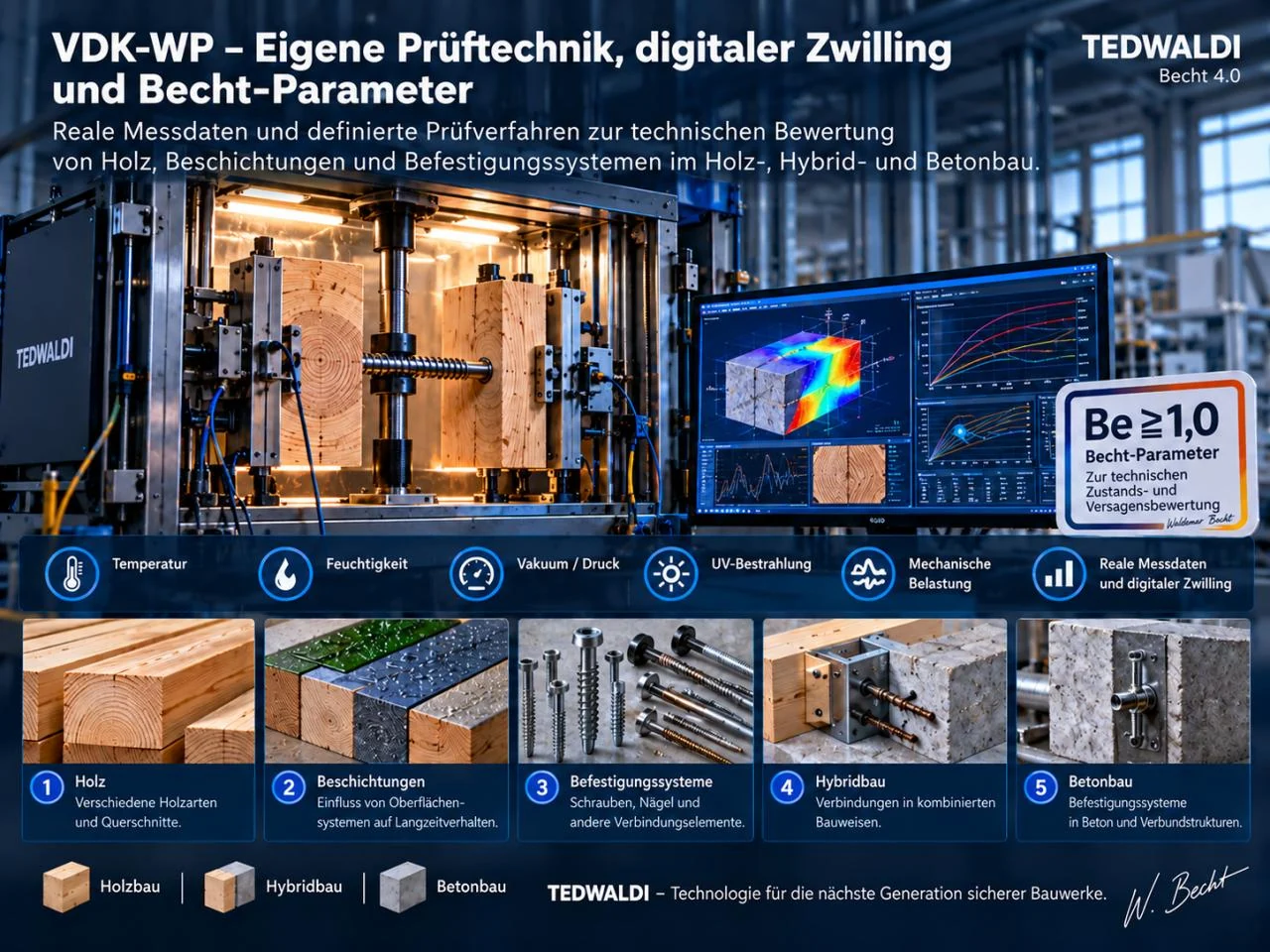
Proprietary methods for dynamic loading, ageing, durability, coatings, fasteners and technical remaining-service-life assessments.
Learn more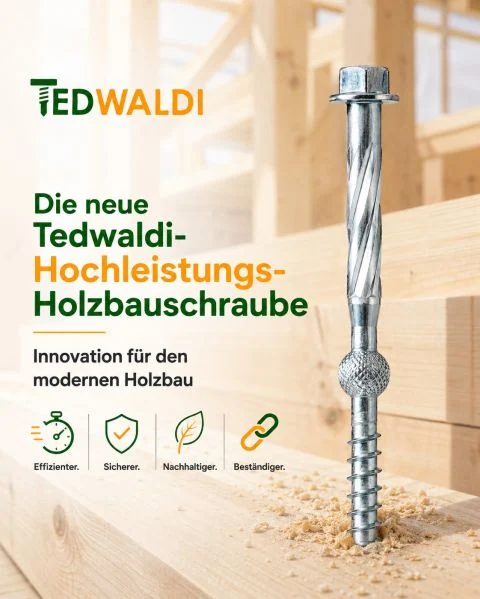
My own screw and spring-screw developments for modern timber and hybrid construction.
Learn moreMoisture, temperature, creep, settlement, installation deviations and repeated loads can affect components and connections over long periods. Looking only at their condition on the day of installation is therefore insufficient.
My approach combines practical development and experimental investigation with digital models as a foundation for understandable, traceable technical decisions.
Discover VDK-WP and the Be parameter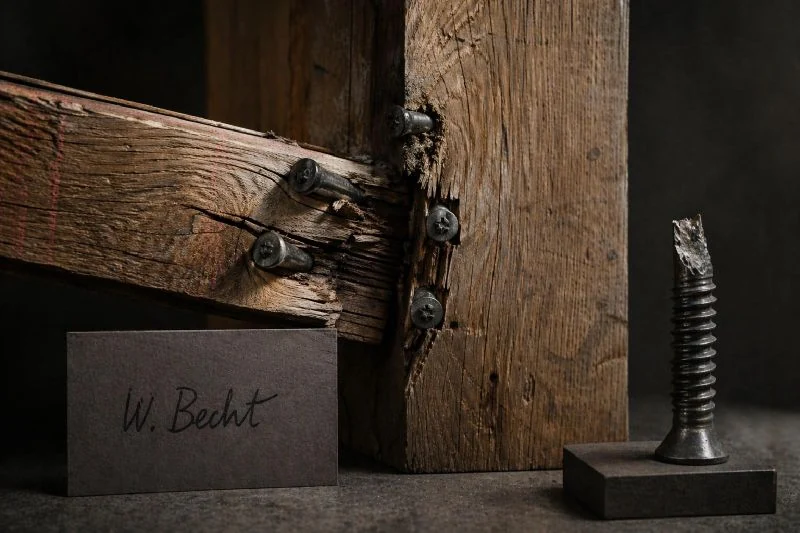
For the entire construction and manufacturing industry: from architecture and structural engineering across all trades to operation, ageing, damage and the end of a structure's service life.
My Becht 4.0 ecosystem connects BIM, AR, intelligent tools and AI with my own products, test methods and self-developed mathematical models for the digital twin. It aims to link planning, actual execution, condition monitoring and forecasts in a traceable way.
Explore the Becht 4.0 ecosystem →Becht 4.0 is conceived for the entire construction and manufacturing industry, from planning to the later investigation of changes and damage.
Design specifications, calculations and technical approvals as a continuous basis for real-world execution.
Checking manufacturing and installation against design requirements, including documented work steps.
Track technical conditions, inspections, changes and procedures throughout the full operating life.
The technical documents present products and testing methods I developed, mathematical assessment approaches, and the integration of measured data with digital models. Technical illustrations can be opened in high resolution.
All 13 technical panels from the experience and development section are included, from mineralization to connection systems and test evidence.
Explore research & practice →Founder and Managing Director of TEDWALDI GmbH · Research and development of timber connection systems.
My work focuses on long-term behaviour, durability and failure mechanisms in technical connections. I develop my own test rigs, testing methods and assessment approaches to make changes measurable and technical decisions traceable.
These include the VDK-WP test method, the Be parameter, screw and spring-screw systems, and the broader Becht 4.0 ecosystem. My work also includes practical applications of selected developments and international scientific exchange.
Projects, exchanges and press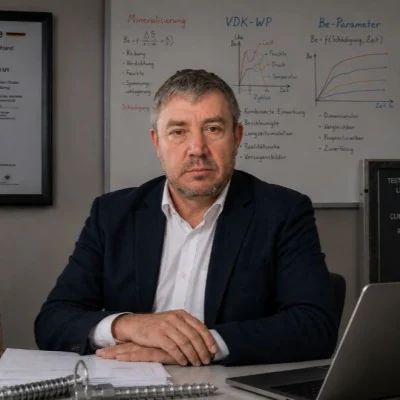
I am Waldemar Becht, founder of TEDWALDI GmbH. In my own research, I discovered, investigated and technically explained the damage mechanism at wood–screw contact zones that I call “Mineralization in Timber Construction”. My explanation describes how moisture fluctuations, relative movement, friction, abrasion, compaction, a hardened contact zone and long-term stress concentrations interact.
Discovery and technical explanation by Waldemar Becht. Assessment of any specific damage depends on the relevant test and measurement data.
Wood does not remain unchanged throughout its service life. Moisture, temperature, swelling, shrinkage and mechanical stresses can cause relative movement between wood and a fastener.
My explanation of the mechanism: repeated moisture and temperature changes cause relative movements at wood–screw contact zones. Friction and abrasion produce particles that become compacted under load. A hardened contact zone develops, which I refer to as the “mineralized zone”.
The wood continues to move while the hardened contact zone restricts movement. This creates stress concentrations, especially at critical transitions along a screw. In my model, this chain of processes explains progressive damage and the eventual failure of a wood–screw connection.
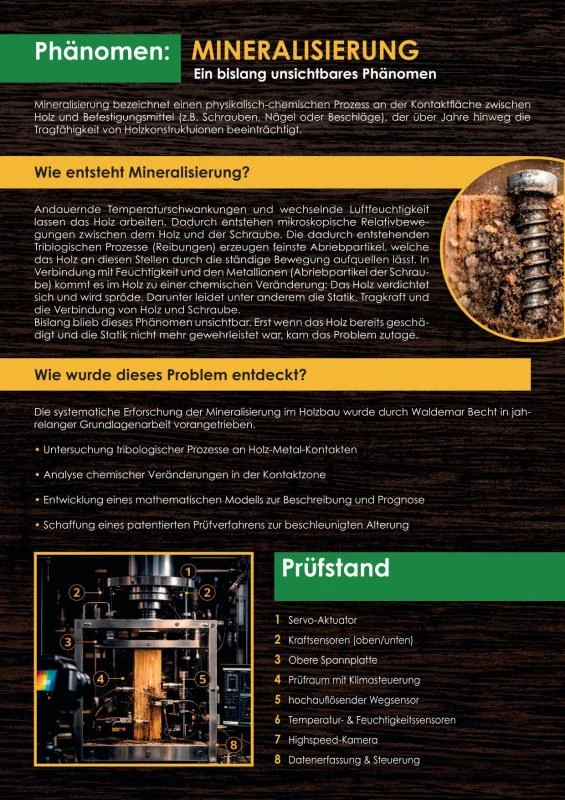
The following process chain shows the mineralization mechanism I discovered and explained in timber construction, step by step.
The graphic panels have not been redrawn. Click them to view the originals at full size.
My illustration of changes at the wood–screw contact zone and the mechanical and climatic influences I have studied.
Learn more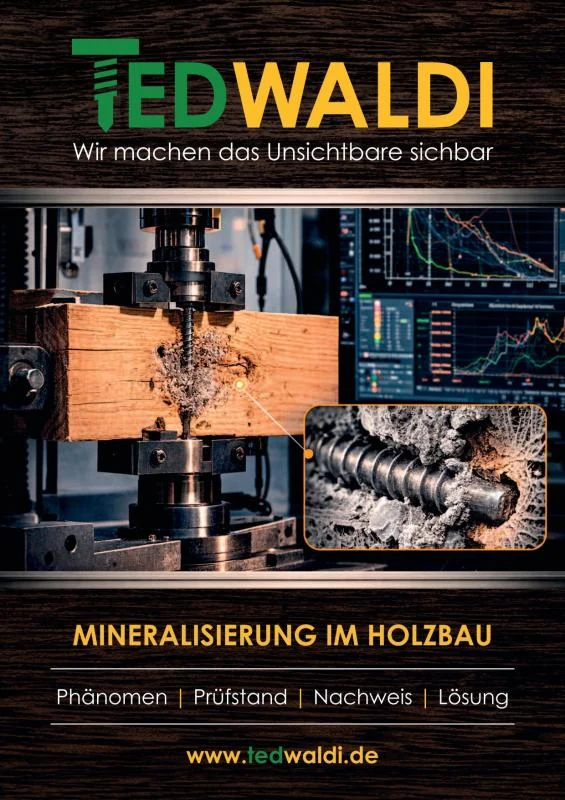
Original TEDWALDI overview of my investigations into the phenomenon, evidence, testing technology and structural solution.
Enlarge illustrationLarge original illustration of the process I describe: moisture changes, friction, abrasion, compaction and a potential fracture zone.
Enlarge illustration“Wood moves: it swells and shrinks with moisture. Yet at the contact surface with a screw, a slow process can develop over the years, weakening the connection without being externally visible.”
Waldemar Becht · Original graphic “Mineralization – a hidden phenomenon in timber construction”
A screwed connection need not fail immediately on installation. Its environment changes: moisture and temperature fluctuations, loads, settlement and the history of use affect wood and fasteners over years.
My explanation shows how the hardened contact zone can impede further wood movement and thereby promote local stress concentrations. Such damage can develop over years. Whether this mechanism caused a particular fracture must be assessed through testing and measurements.
The key questions are: How does damage arise? Where does it occur? When does it begin? How can it be tested? And which design can reduce unfavourable processes?
A screw connection does not have to fail immediately upon installation. The environment changes: moisture and temperature cycles, loads, settlement and its history of use affect the wood and fasteners over time.
My explanation shows how a hardened contact zone restricts further timber movement, encouraging local stress concentrations. Such damage can develop over years. Whether this mechanism caused a particular fracture must be assessed through tests and measurements.
The decisive questions are: How does damage arise? Where does it develop? When does it begin? How can it be tested? And what construction design can reduce adverse processes?
After approximately 2.5 years, Waldemar Becht compared screws installed indoors in the same timber and under comparable environmental conditions, but using different installation methods. The results illustrate that contact zones change even without outdoor weathering.
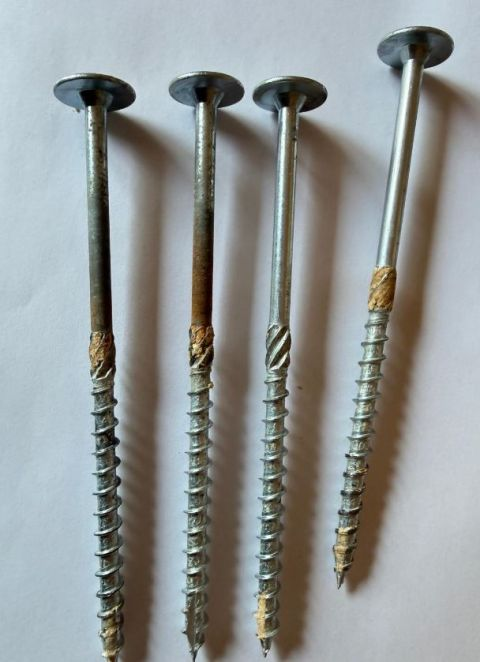
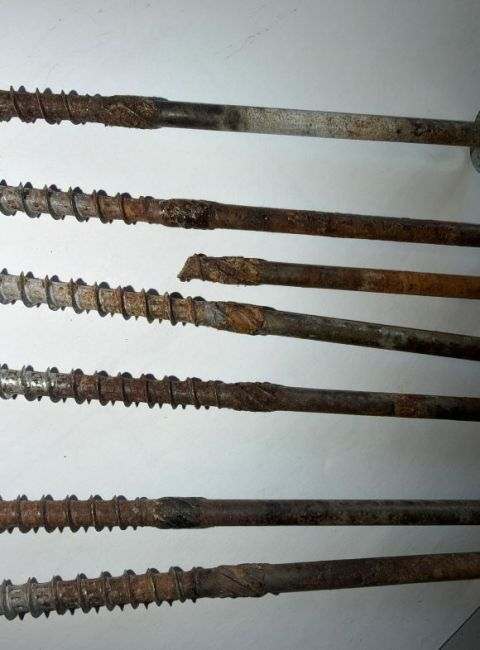
Cases of early screw fractures after about 1–2 years show that these changes can matter long before several decades have passed. VDK-WP testing and proprietary mathematical models are used to study such relationships.
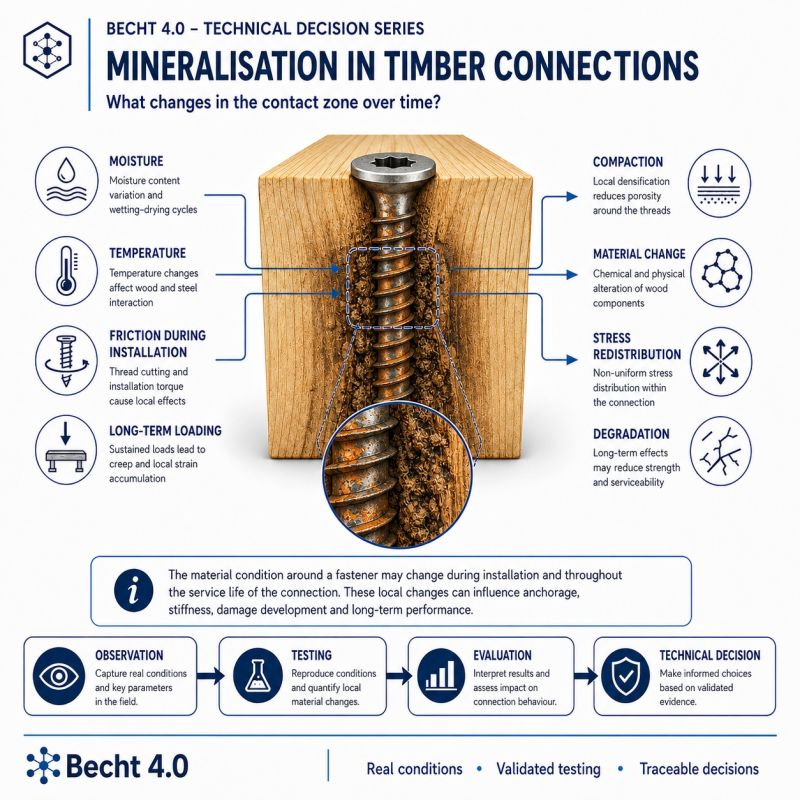
To study this mechanism under controlled conditions, I developed my own testing and assessment approaches. VDK-WP combines mechanical and climatic stresses with real measurement data; my self-developed mathematical models connect these results with the digital twin.
The Be parameter is another part of my approach to technical condition and failure assessment.
For connections to remain safe over the long term, it is not enough to look only at the condition immediately after driving the screw.
Designers need to know how real connections may behave under repeated changes in their environment.
Manufacturers and installers should be able to identify possible causes of later damage and examine suitable construction principles.
Testing institutes, experts and researchers can compare specific fracture patterns, test results and material conditions.
In other technical contexts, “wood mineralization” can also mean the intentional incorporation of mineral substances for example to modify material properties.
By “Mineralization in Timber Construction” I mean the damage mechanism at wood–screw contact zones that I discovered and technically explained: movement, friction, abrasion, compaction and a hardened contact zone. This is not intentional treatment or mineral enhancement of wood.
Making this distinction explicit prevents misunderstandings and accurately positions my research on mineralization at wood–screw connections. within its technical context.
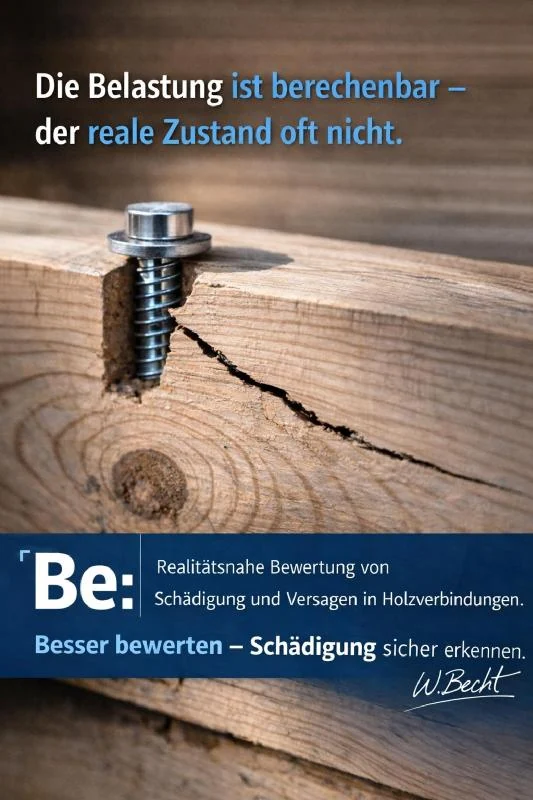
Answers to common questions about my discovery and potential long-term damage to timber connections.
I use it to describe the damage mechanism I discovered at wood–screw contact zones: moisture and temperature fluctuations, movement, friction, abrasion, compaction and the formation of a hardened zone.
I, Waldemar Becht, discovered and investigated this relationship during my own research and development, and explained it as “Mineralization in Timber Construction”. My technical panels document the explanation and the resulting testing and solution approach.
Over the years, moisture, temperature and changing loads alter the behaviour of wood and screws. My model explains the formation of a hardened contact zone and the resulting stress concentrations. For each specific fracture, the cause must be demonstrated by testing and measurement data.
According to my explanatory approach, damage can develop in the contact area without being immediately visible on the wood surface. Appropriate test methods and measurement data are therefore important.
VDK-WP is my own testing technology for accelerated investigation of long-term influences, including climate, dynamic loading and movement. I link the measured results to my own mathematical models and digital twin.
No. My term describes the damage mechanism I have identified at a wood–screw contact zone. Intentional mineralization, by contrast, introduces mineral substances to change the properties of wood.
I am Waldemar Becht, founder and Managing Director of TEDWALDI GmbH. Observing long-term damage to timber connections is one of the starting points of my development work. My explanation of mineralization has raised technical questions that I address through my own testing methods, assessment approaches and connection technologies.
On this website, I present my own documents, technical considerations and original illustrations of the phenomenon investigated. Independent scientific claims concerning frequency, chemical composition or specific threshold values require suitable research and reliable evidence in each case.
Becht 4.0 is my integrated technological ecosystem of proprietary product, testing, tool, calculation and modelling developments. It connects BIM, AR and intelligent manufacturing with my own mathematical models for the digital twin across all trades and the entire life cycle of a structure.
Overall technological concept and development work – not a claim that all functions have already been fully implemented or approved by building authorities.
“The construction industry does not lack data.
It lacks sound technical decisions.“
Technical safety requires connected information from real construction and manufacturing practice, not merely individual models, sensors or documents.
An architect's design, a structural engineer's calculations, actual manufacturing, installation and subsequent operation belong together from a technical standpoint. In practice, information is often kept separately. When conditions change years later, the connections between individual data sets are frequently missing.
My ambition extends beyond fasteners: walls, roofs, load-bearing structures, construction materials, surfaces and coatings are as much part of the life cycle as manufacturing, installation, dynamic loads, ageing and the technical condition after fire damage.
Becht 4.0 aims to combine precisely these layers, enabling consistent technical assessment: What was planned? What was actually made? What was installed? What has changed? What technical decision is needed?
With traceable information on planning, execution, testing, condition and life cycle, supported by my own mathematical assessment logic, a digital twin and AI-assisted analysis.
Each technical layer affects the next. The ecosystem is intended to connect this information across all trades.
Becht 4.0 is not simply another standalone software product. Its technological layers are intended to work together.
Digital building models and related information should serve as a verifiable basis for actual construction.
Connected tools should compare planning specifications with actual manufacturing and installation, and document completed work.
My VDK-WP and AntiFire developments combine testing of materials, components, surfaces, coatings and fasteners with real loads.
I conceived my own digital twin on the basis of mathematical models that I developed myself. It links real test and condition data with time-based calculations.
My own mathematical models and AI are used to systematically assess measured conditions, dynamic stress, ageing and predicted remaining service life.
Technical decisions should be transparent, justifiable and permanently documented.
I developed the mathematical core of my digital twin myself. My models combine test data, dynamic loads and changes in materials and condition with numerical assessments of long-term behaviour.
They are intended to enable traceable assessment and forecasting of the condition of the entire structure, its components, surfaces, coatings and fasteners throughout its service life. Assessing remaining service life after exposure to fire is also part of my development approach.
A key development goal is to compare the planned and approved model with actual construction. This includes not only geometric deviations, but also the components and fasteners used, completed installation steps and technical boundary conditions.
The illustration describes the intended functional principle; specific technical implementations are not disclosed.
Becht 4.0 is conceived for businesses, professionals and institutions throughout the entire life cycle.
Relate models, calculations and requirements to real-world execution.
Record automated production and specific component data as part of a structure's history.
Manage execution clearly, identify deviations and trace installation steps.
Assess technical condition and changes over the entire service life.
Review verifiable documentation and the technical basis for decisions.
Use recorded structural and condition information for technical root-cause analysis.
Damage patterns alone do not automatically explain their cause. Linking design, manufacturing, installation, testing, use and actual condition can help reconstruct technical relationships.
Becht 4.0 aims to bring this information together over the long term so that changes can be identified and possible causes systematically examined. This supports experts in their assessments but does not replace the necessary technical or legal review.
No. The ecosystem is intended for the entire construction and manufacturing industry. My developments in timber and hybrid construction are important starting points, but they do not limit the envisaged scope of application.
No. The approach describes an integrated technical ecosystem comprising my own developments, test methods, intelligent tools, digital models, AI and a traceable decision-making and approval logic.
BIM provides important design information about the structure. AR can make information visible during actual execution and inspection. Becht 4.0 aims to link these levels with real manufacturing and installation.
That is a central development objective: technical data collected over time should make changes, causes and relationships easier to understand. Whether a specific cause can be established with certainty depends on the quality and completeness of the available information.
After a fire, fire resistance is not the only relevant question. With my AntiFire testing and assessment approach, I examine the condition of construction materials, coatings, connections, fasteners and entire components. My own mathematical models for the digital twin are used to calculate and forecast residual load-bearing capacity and remaining service life.
Independent development area. The provided visualisations are technical concept illustrations, not certificates of completed fire tests.
What matters is damage, remaining material and connection properties, residual load-bearing capacity, and how long a component can still be used after fire exposure under defined conditions.
Temperature distribution, damage and ageing of materials, coatings, components and fasteners.
Remaining mechanical properties and load-bearing capacity based on test and calculation data.
Forecast remaining service life to guide further testing, repair, strengthening, continued use or replacement.
Technical assessment after a fire concerns more than one component. It covers materials, components, connections, fasteners and coatings.
What thermal and mechanical changes have occurred in timber, concrete, steel and hybrid components?
Which properties remain under actual boundary conditions, including fasteners and connection systems?
My mathematical models combine test values and loads to produce forecasts and technically grounded assessments after fire damage.
A specific result requires appropriate data, a suitable testing scope and expert assessment of the structure concerned. This illustration is no substitute for individual proof of safety.
My AntiFire approach combines real fire exposure, sensor and measurement data with my own mathematical models for the digital twin. On this basis I am developing technical calculations and forecasts of the remaining condition and service life after fire damage.
My cross-material approach covers timber, concrete, steel, hybrid and composite structures, coatings, fasteners, as well as walls, roofs and load-bearing structures. The applicability and significance of any test depend on the specific test object and supporting evidence.
Systematic experimental and measurement data as a basis for investigating technical relationships.
Traceable information for assessing condition and residual load-bearing capacity.
A better technical foundation for decisions after fire exposure.
My own testing and assessment methods cover not only fasteners but also entire components, walls, roofs, materials and coatings. I examine dynamic loads, ageing and durability, linking measurement data with my own mathematical models to assess condition and remaining service life.
Initial load-bearing capacity is not the only factor: materials, fasteners, coatings and whole structures change under climate conditions, cyclic loads and sustained stress. My studies link durability and ageing with the question of remaining useful life.
With VDK-WP, I examine these influences under controlled, accelerated conditions. Measured changes are linked to my self-developed mathematical modelling and my own digital twin.
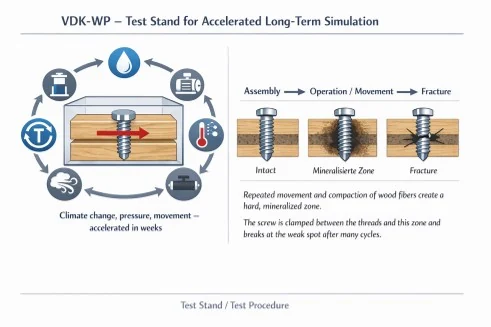
The Be parameter I developed forms part of my assessment approach, designed to capture and interpret changes, damage and possible failure processes in technical terms.
My original illustrations include a threshold value presented as a failure indicator. This approach must not be equated with a universally binding building-code design rule.
The original illustrations explain a mechanism I have investigated in which movement, friction and local compaction at a connection may promote a hardened zone.
Wood moves. Moisture, swelling, shrinkage and repeated stresses alter contact conditions between wood and fasteners. My investigative approach examines how local stress concentrations and long-term damage may develop as a result.
Understanding these processes forms the basis both for testing methods and for structural solutions that deliberately accommodate movement.
My discovery in detail →Original illustrations showing details of test rigs, test parameters and potential applications.
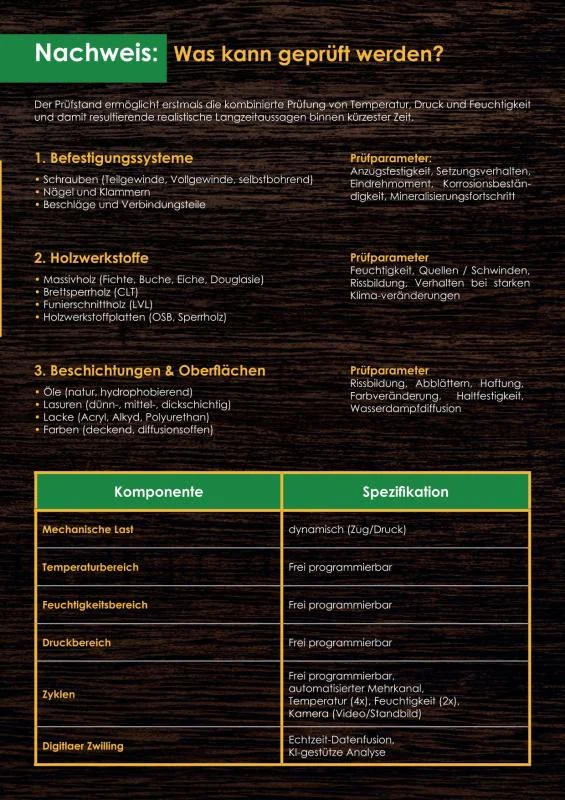
Investigating the properties of fasteners, wood-based materials and surfaces.
Enlarge illustration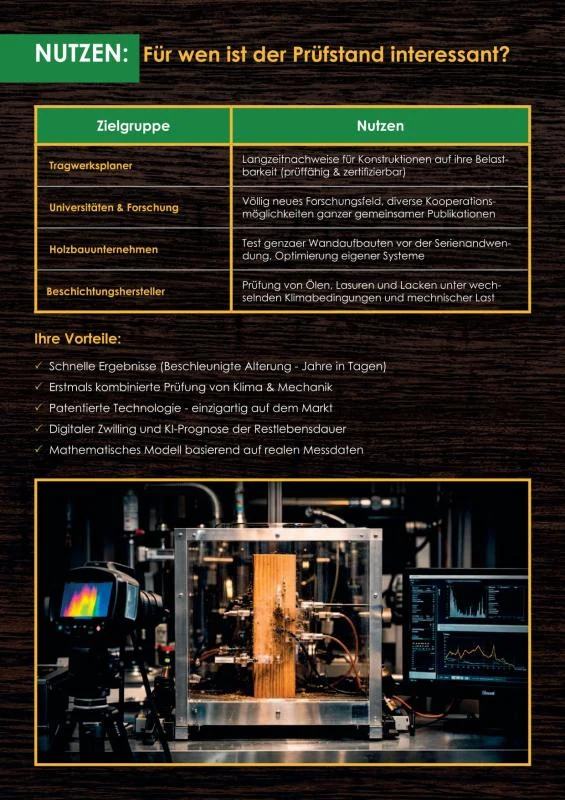
Context for structural design, research and industrial development.
Enlarge illustration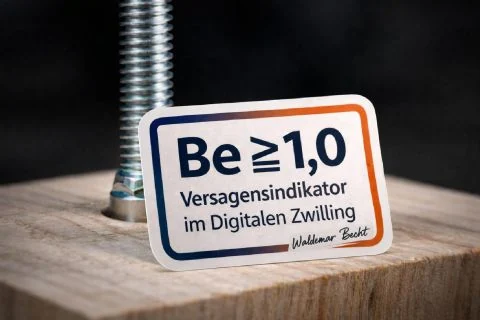
Original illustration of technical condition and failure assessment.
Enlarge illustrationFundamental research questions concerning screw connections and potential failure mechanisms.
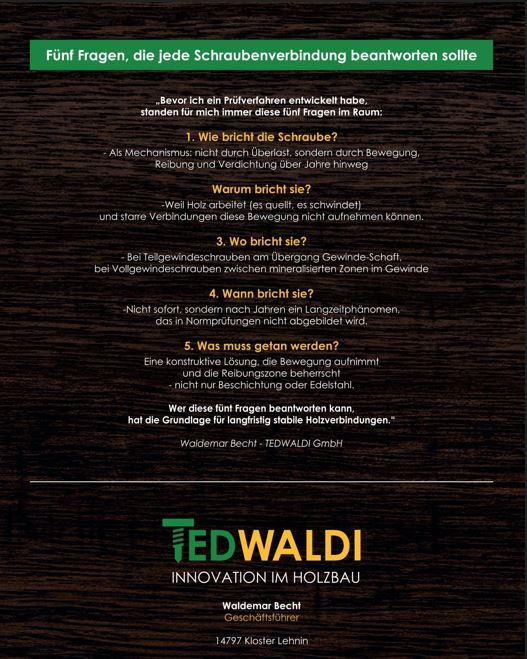
Research questions about the cause, timing and location of failure, and structural improvements.
Enlarge illustrationMy testing technology and assessment models go beyond wood–screw connections: they examine technical changes in components, materials, surfaces and whole structures.
Durability, ageing, climate and load effects in structures and their components.
Testing coatings on timber, walls and other materials, as well as the behaviour of connection and fastening systems in hybrid structures.
Measurement, assessment and calculation under repeated loading, including condition after fire damage.
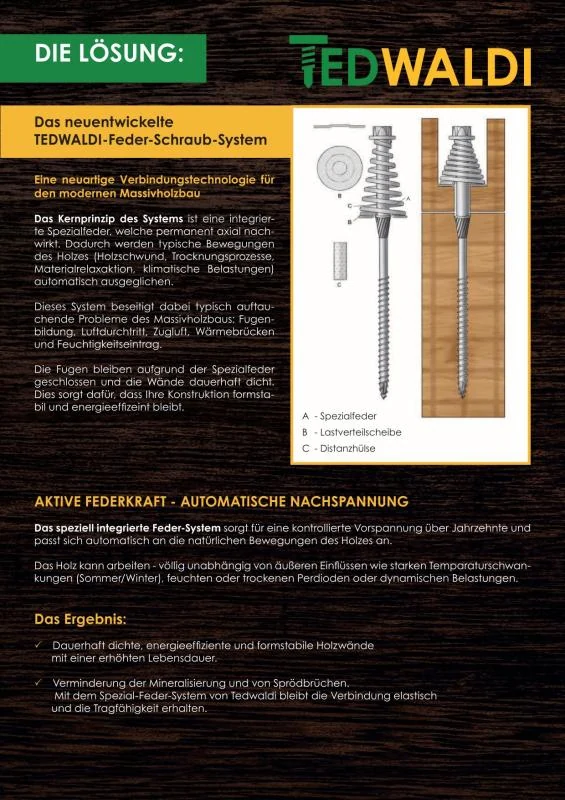
My screw and spring-screw systems account for wood swelling, shrinking and changing under load over the years. This development approach combines controlled load transfer, accommodation of structural movement and easier installation.
Timber and other construction materials change their dimensions and properties due to moisture, temperature, sustained loads and installation conditions. Rigid connections may therefore experience unfavourable restraint forces or stress concentrations.
My spring-screw development aims to combine defined preloading and controlled accommodation of time-dependent movement in a single connection system.
The provided original panels show design principles, variants, installation procedures and intended application advantages.
The connection must fulfil its structural function.
Take account of moisture-related changes and time-dependent deformations.
Make installation processes controllable and traceable.
Enable technical properties to be assessed even years later.
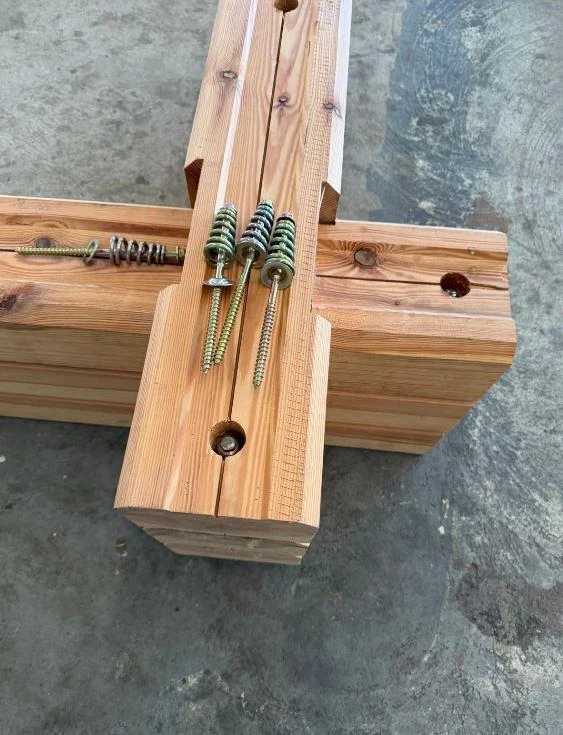
According to my professional profile, selected developments have been investigated by external test institutions and used in construction projects. One spring-screw system described there was used in a public timber construction project in the Munich area.
My connection technologies are part of a broader proprietary ecosystem: investigations of materials, coatings, dynamic loads and remaining service life feed into my testing technology and mathematical models for the digital twin.
The specific test evidence applies to the stated test object. It does not constitute blanket approval or confirmation of all development claims.
View project context and evidenceTechnical drawings and development panels appear alongside their subjects. Click an illustration to enlarge it.
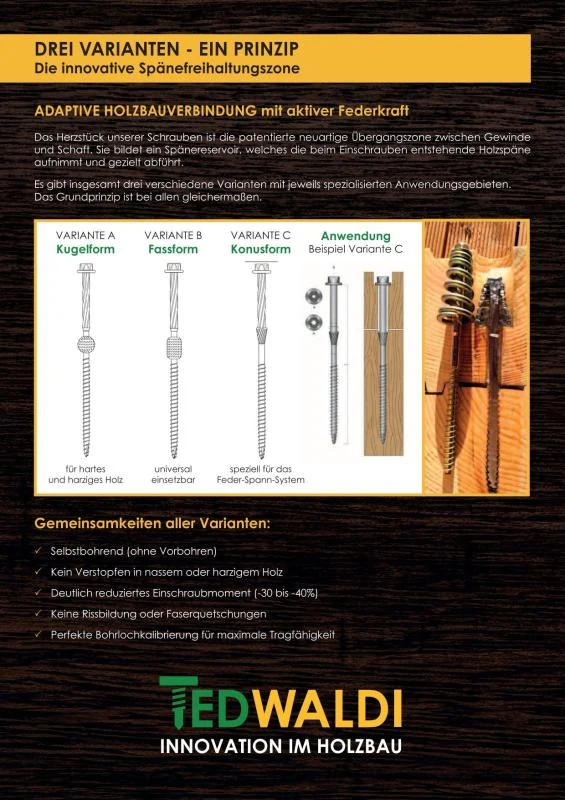
An overview of the chip-clearance zone and different design variants.
Enlarge illustration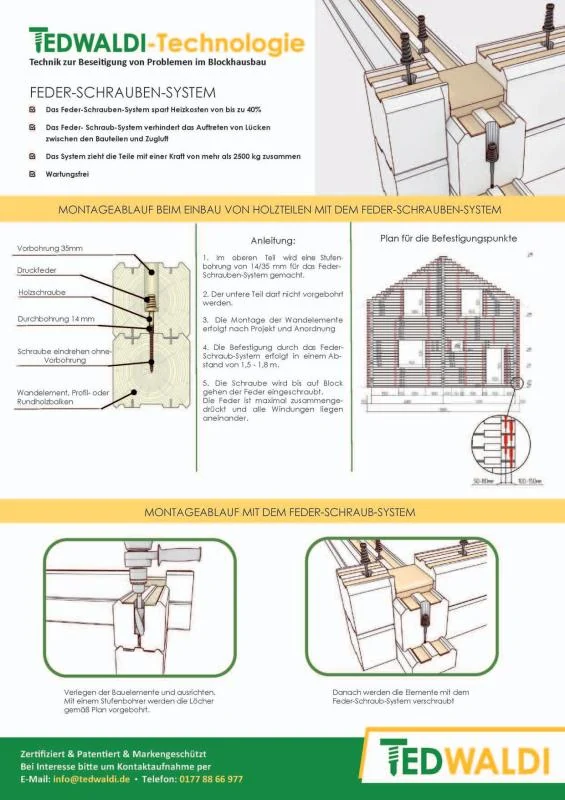
Technical installation sketches and the essential steps of the connection principle shown.
Enlarge illustration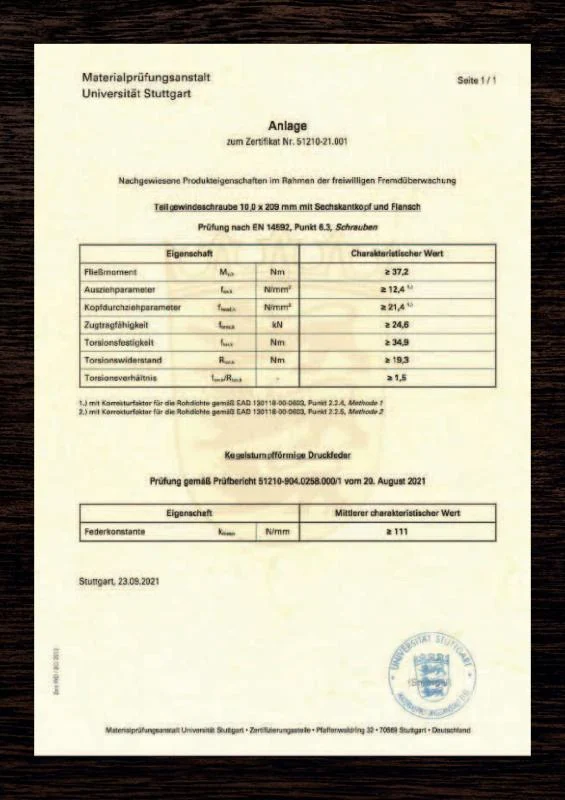
Provided document with reported parameters for a specifically identified test object.
Enlarge illustrationInstallation, properties and application areas of the screw and spring-screw systems.
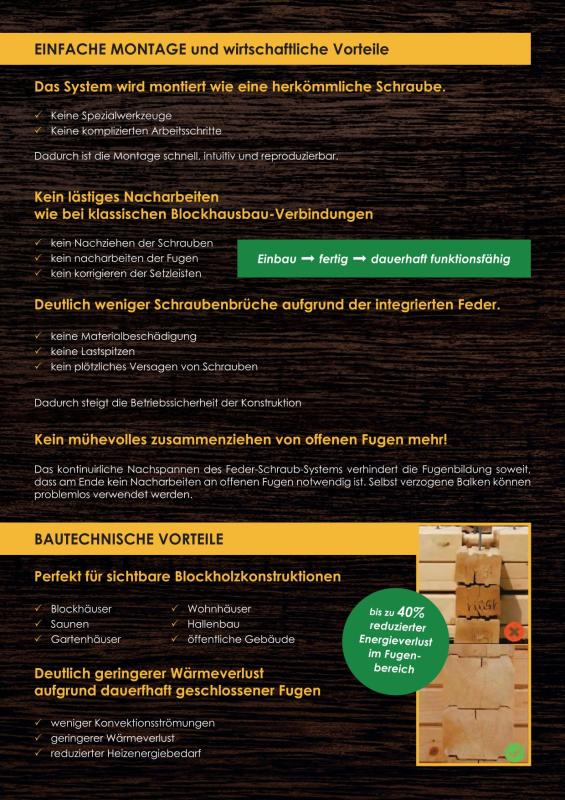
Installation procedures and possible economic advantages of the spring-screw system.
Enlarge illustration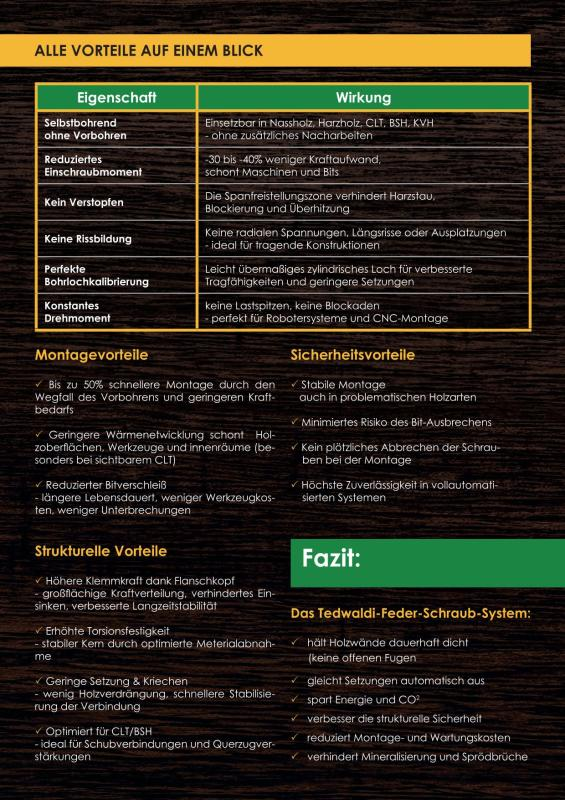
Overview of the described mechanical, structural and installation properties.
Enlarge illustration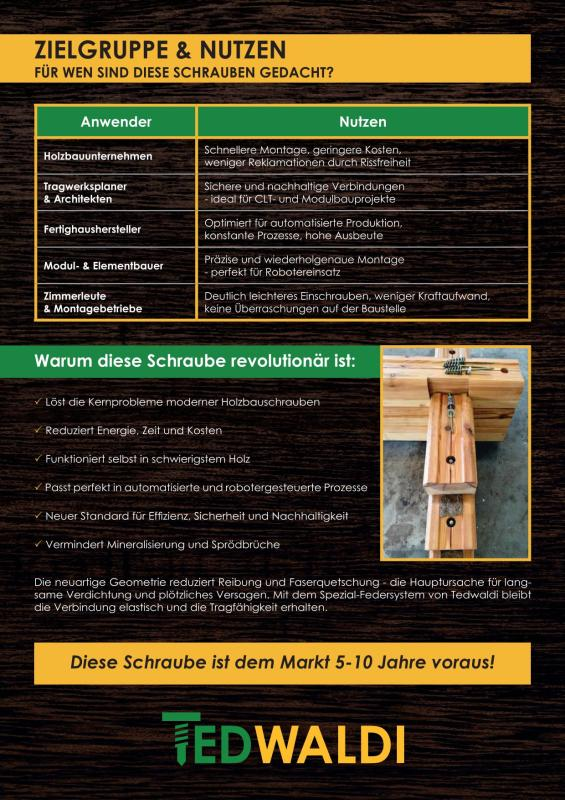
Applications for designers, timber construction companies, prefabricated-house manufacturers and industrial assembly.
Enlarge illustrationTechnical research becomes reliable when assumptions are tested, failure mechanisms are understood and solutions are compared with real results. My work connects research and development with specific construction challenges.
Selected topics from the information and images I have provided.
According to my profile, a connection system I developed was used in a public timber construction project in the Munich area.
Learn more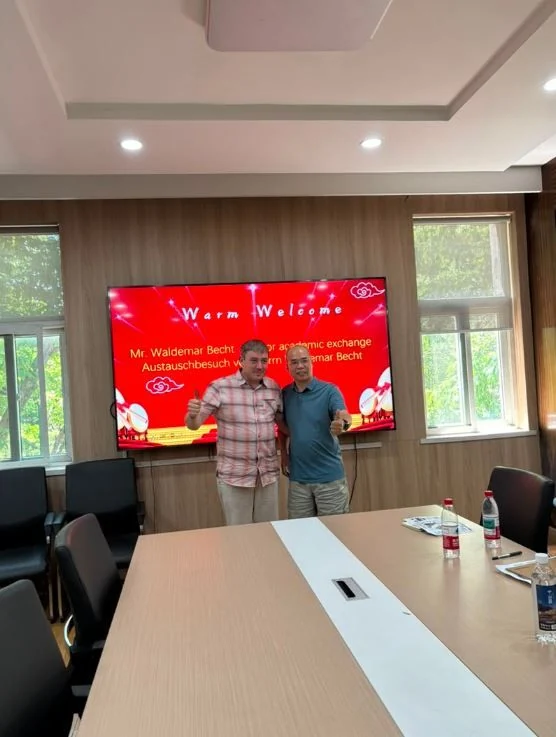
On 15 July 2026, another in-person professional exchange took place with Professor Que Zeli and his team.
Enlarge illustration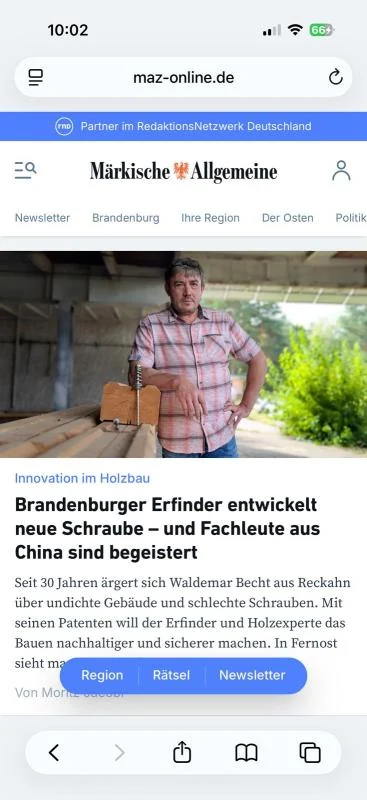
The regional newspaper Märkische Allgemeine reported on my screw and connection systems and my development approach.
Enlarge illustrationThe provided documents include a sheet from the Materials Testing Institute at the University of Stuttgart containing parameters for a particular screw test object.
A test report provides technical evidence for the specific object and testing framework to which it relates. Other products, systems or applications require their own evidence.
Registered intellectual property: DE 20 2025 107 109 U1 – a development involving screw and connection systems listed among the registered rights in my profile.
Selected topics from my published posts, summarised for general readers.
Planned service life, actual loads, installation conditions, moisture and changes must be considered together over the years.
The technical condition after fire exposure can be just as important as the duration of fire resistance.
Linking design, testing, installation and condition across the life cycle forms a foundation for Becht 4.0.
Regional value creation and the actual technical potential of local timber species are part of responsible material use.
Connection quality also depends on transport, installation, use, climate and later interventions.
Calculations, actual execution, test data and condition information must be converted into traceable technical assessments.
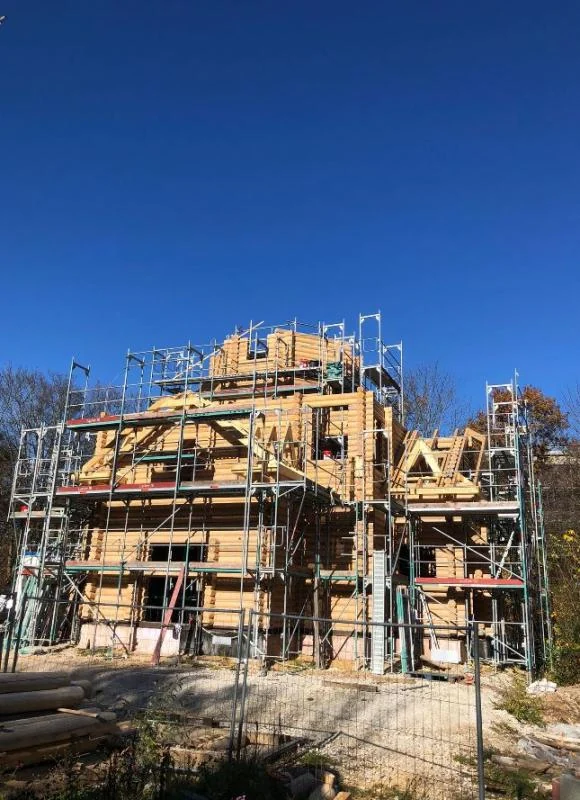
A system should not be judged solely on a test rig or in the design phase. Manufacturing, installation conditions and actual use may decisively affect long-term reliability.
That is why I connect my own product developments, testing technology and self-developed mathematical models for the digital twin. My research also covers construction materials and coatings, dynamic loads, ageing, durability and the calculation of remaining service life after fire damage.
Waldemar Becht · TEDWALDI® · Research, testing technology and connection technologies. Please write to me directly, preferably with a short description of your topic.
WhatsApp for written messages only. No invitation to call.